
How to Plan a Seoul Beauty Clinic Trip in 2026: The Complete Foreigner’s Checklist
·
🗂️ Planning Your Trip
·
⏱️ 11 min read
How to Plan a Seoul Beauty Clinic Trip in 2026: The Complete Foreigner’s Checklist
She spent ₩2,000,000 in Seoul. Two weeks later, her skin was angrier than before she left. The clinic wasn’t a scam. The treatments were real. She did Rejuran on day one, Ultherapy on day two, a chemical peel on day three — from clinics with English-speaking staff and spotless lobbies. The problem wasn’t the quality of care. It was the system — and how it moves.
Seoul’s aesthetic medicine infrastructure is built for cumulative results and repeat visits. Locals spread treatments across months. Collagen rebuild timelines. Dermal repair cycles. The system is optimized around a patient the clinic knows. When a first-time foreigner walks in wanting results in four days, they’re feeding a foreign variable into a machine designed for something else entirely.
This isn’t a mood board for your trip. It’s the actual ops plan.
Understanding the Clinic System Before You Book Anything
Every mid-to-large Seoul clinic operates around a consultation manager — a process optimization specialist whose job is to design the most efficient treatment combination for your budget and skin condition. The system works beautifully for regulars. A Seoul resident who visits every six weeks has a known baseline — skin’s recovery behavior, pain tolerance, last treatment date. The optimization is tight because the variables are known.
For a first-time foreigner, the variables aren’t known — and the efficiency gap works against you. You’ll be offered a treatment plan that is technically correct. What it won’t account for: your skin has never encountered these procedures before, you’re flying home in five days, and “some redness for 2–3 days” lands differently when your next stop is a beach in Bali.
Inject your variable into their optimization equation. Tell them explicitly: your trip duration, your recovery tolerance, your next major social commitment, and whether you’ve had any of these treatments before. Don’t assume they’ll ask. They’re optimizing for your skin — not your itinerary.
According to a March 2026 post on r/KoreaSeoulBeauty cataloguing common foreigner misconceptions: “Korean aesthetic training prioritizes cumulative effect over instant transformation.” That’s not a polite disclaimer. It’s the clinical philosophy driving every treatment plan in the building.
Factory Clinic vs. Boutique Clinic: The Real Distinction
The most important planning decision isn’t which treatment to get. It’s which type of clinic to get it from. These two models are structurally different.
| Feature | Factory Clinic | Boutique / 1:1 Clinic |
|---|---|---|
| Consultation lead | Consultation manager (ops role) | Doctor-led from first session |
| Room setup | Shared bays, high throughput | Private rooms, longer sessions |
| Price point | Lower — volume drives the model | Higher — doctor access is the product |
| Best for | Botox, Shurink, skin boosters | Ultherapy, fillers, complex combinations |
| Foreigner risk level | Low for simple treatments; higher for complex | Low — doctor-supervised throughout |
The 2026 r/KoreaSeoulBeauty clinic price survey put it plainly: “You consult with a sales manager, not a doctor” — that’s the factory clinic reality. For straightforward Botox or a Shurink session, that’s fine. For Ultherapy or filler work where real-time adjustment matters, it’s a structural mismatch. The Creatrip clinic guide breaks down specific clinic types by district and treatment specialty — a useful starting shortlist before arrival.
The Price Truth: Equipment Authenticity Matters More Than Discounts
Seoul has genuine price variance between clinics doing identical procedures. Some reflects marketing overhead and location. Some reflects consumable quality, equipment authenticity, and whether the device being used on your face is actually the device it’s supposed to be.
The VAT refund for cosmetic and aesthetic treatments was abolished permanently. Build your budget at face-value prices. The 10% some older Seoul beauty trip guides factor in no longer applies — full details at Evita Clinic.
2026 Price Reference
| Treatment | Budget Range | Premium Range | Notes |
|---|---|---|---|
| Ultherapy (300 shots) | ₩900,000 | ₩1,500,000–₩2,000,000+ | Budget end often lacks detailed design process |
| Shurink Universe (300 shots) | ₩200,000–₩300,000 | — | Budget HIFU alternative; solid for maintenance |
| Rejuran Healer (2cc) | ₩280,000 | ₩450,000 | Ask for numbing cream 30 min before |
| Botox — Korean brands (per area) | ₩20,000–₩50,000 | — | Nabota, Coretox — clinically equivalent to Allergan |
| Botox — Allergan imported | 2–3x Korean brand price | — | Brand premium, not a performance premium |
| Skin Botox (full face) | ₩150,000 | ₩300,000 | Micro-injection protocol; different from wrinkle Botox |
| Sedation add-on (Ultherapy) | +₩100,000 | +₩200,000 | Worth it at low pain tolerance — Ultherapy is intense |
| Cryo/aftercare (in-clinic) | +₩30,000–₩50,000 | Included at some boutiques | Clarify before booking |
Potenza: Ask to See the Tip Opened In Front of You
Potenza uses single-use tips as a core consumable — a genuine cost line and a legitimate reason for price variance between clinics. If a clinic’s pricing is noticeably below market, ask them directly: “Can I see the tip packaging opened before we start?” A confident clinic has no issue with this. Hesitation is your answer.
Reused microneedling tips carry a real cross-contamination and infection risk. This is the specific scenario where budget pricing becomes a genuine safety concern. Verify before you get on the table.
Ultherapy: Verify Before You Book
Ask whether the clinic uses Ulthera Prime. Merz maintains a publicly accessible registry of verified clinics at merz.co.kr. The 2026 update added direct equipment serial number verification — a layer that non-genuine or reused equipment cannot pass. Cross-reference your shortlisted clinic before paying a deposit.
Building a Treatment Timeline That Actually Works
The single biggest planning error is sequencing treatments for maximum coverage rather than for recovery. A 4-night trip realistically supports one significant procedure with full recovery, or two mild procedures with careful spacing — not four treatments across consecutive afternoons.
The Hotel Room Recovery Kit
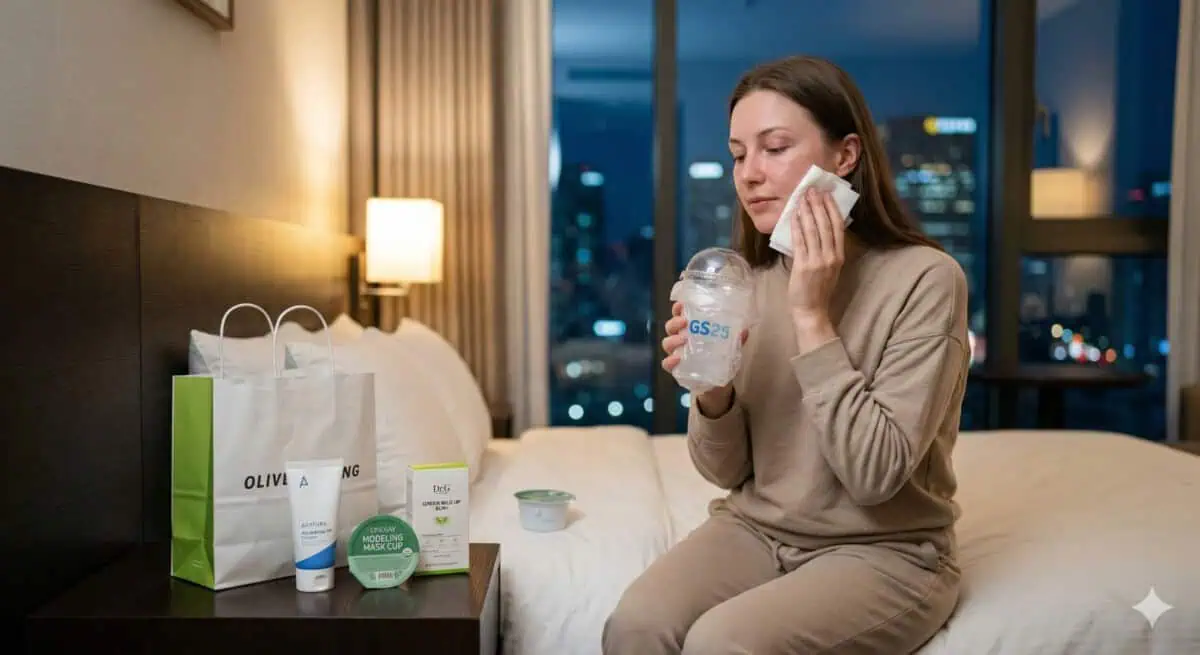
Your clinic handles the treatment. Your hotel room handles the recovery. Everything below is available at Olive Young — the Korean beauty pharmacy chain with multiple Gangnam locations. Budget ₩60,000–₩90,000 for the full kit. It earns back far more than another add-on treatment.
Lindsay Single-Use Modeling Mask Cups
Alginate-based modeling masks that create a cooling, occlusive seal over treated skin. Unlike sheet masks, they set and lift cleanly without dragging on freshly treated skin. Use the evening of your procedure. Available in single-use cup format — no mixing bowls needed. Roughly ₩4,000 per pack.
Aestura Atobarrier 365 Cream
A medical-grade ceramide barrier cream formulated for compromised skin. The primary job post-procedure is reducing transepidermal water loss (TEWL) — the mechanism behind post-treatment dryness, flaking, and delayed healing. The product most consistently cited by Seoul dermatologists for the 48 hours following energy-based treatments. Rich texture; use sparingly if your skin runs oily.
Dr.G Red Blemish Clear Soothing Cream
If Atobarrier 365 is too heavy for your skin type, this is the alternative. Centella asiatica-based soothing formula in a lighter emulsion texture — designed for acne-prone and oily skin that still needs ceramide barrier support without clogging. You’ll often see it on the clinic’s own aftercare shelf, which tells you something.
Dr.G Green Mild Up Sun+ SPF 50+
A physical (mineral) sunscreen using non-nano zinc oxide — what Korean shelf labels call mugijacha, the term to look for. Chemical UV filters are contraindicated on freshly treated skin; mineral sunscreen is not. This formula runs lightweight with no white cast. Post-procedure, SPF is not optional. Apply every two hours if you’re going outside.
The Convenience Store Ice Cup Method
Walk into any GS25, CU, or 7-Eleven and buy an ice cup — ₩800 to ₩1,200. Transfer to a thin plastic bag, wrap in one layer of tissue. Apply 10 minutes on, 10 minutes off. This is the same cryo protocol some clinics charge ₩30,000–₩50,000 extra for. Use the evening of your procedure and the next morning.
For a full product breakdown by skin type, the Olive Young post-treatment guide at Beautipin is the most practical English-language resource currently available.
Where to Stay and How to Book
Post-procedure skin doesn’t want a 40-minute subway ride. Gangnam and Apgujeong-Rodeo are where the highest density of credentialed aesthetic clinics operate. Staying within 15 minutes of your clinic makes the morning-after follow-up realistic rather than exhausting. Find hotels near Gangnam clinics — filtering by Gangnam-gu or Seocho-gu puts you within walking distance of the Apgujeong and Sinsa clinic corridors.
For booking as a foreign visitor, two platforms have built infrastructure specifically for this gap. Creatrip offers translated consultation support and pre-vetted clinics — useful if you want a curated shortlist rather than open-ended research. Klook covers skin and aesthetic clinic slots with English booking support and clear cancellation policies, better if you’re bundling the clinic reservation with other Korea activities on a single platform.
From the Community
“You consult with a sales manager, not a doctor” — factory clinic reality is efficient for high-volume treatments but exposes foreigners to gaps in individualized planning.
— r/KoreaSeoulBeauty 2026 Price Survey
“Korean aesthetic training prioritizes cumulative effect over instant transformation.” This is the philosophical gap causing most foreigner disappointment.
— r/KoreaSeoulBeauty, March 2026 Misconceptions Post
The Actual Operations Plan
One anchor treatment. One clinic type matched to the risk level of that treatment. A hotel in Gangnam. A ₩90,000 recovery kit from Olive Young. Your consultation on day one, treatment on day two. No peel on day three.
The person at the top of this post didn’t fail because she chose the wrong clinic or got substandard treatment. She failed because she ran four procedures in four days without accounting for how her skin would respond — and no one in the consultation room had the full picture of her constraint. The clinics did what they were optimized to do. She didn’t give them the information they needed to optimize for her.
Seoul’s aesthetic medicine is genuinely excellent. You just have to use it correctly.
Frequently Asked Questions
Is it safe to do multiple treatments in one trip?
Do I need to speak Korean to navigate a Seoul beauty clinic?
Is Ultherapy at ₩900,000 worth it, or should I pay more?
What’s the difference between Shurink and Ultherapy?
Can I get a VAT refund on aesthetic treatments in 2026?
What should I avoid in the 48 hours after treatment?
Explore More
Planning Your Trip
Skin & Face Treatments
Clinic & Area Guide
Gangnam Medical Tourism Guide
Sources: r/KoreaSeoulBeauty 2026 Price Survey · r/KoreaSeoulBeauty March 2026 Misconceptions Post · Merz Korea Ulthera Prime Verified Clinic Registry · Beautipin: Olive Young Post-Treatment Guide · Evita Clinic: VAT Abolition 2026 · Creatrip Clinic Guide